
How to Choose Between ABS, HDPE, and TPO for Your Part
When engineers and procurement teams evaluate thermoplastics for manufactured parts, three materials come up as common options: ABS, HDPE, and TPO. Each of these are strong plastic choices in different ways. Each material offers different advantages depending on the environment, performance requirements, manufacturing process, and long-term durability needs of the part.
The challenge is that there is no universal “best” thermoplastic.
A material that performs well for an outdoor agricultural enclosure may fail in a high-impact industrial environment. A material that lowers upfront costs may create durability or cosmetic issues later.
That is why material selection should always be tied to the actual application, not just a single specification like strength or price.
In this article, we’ll compare these three common thermoplastics so you can determine the right choice for your project.
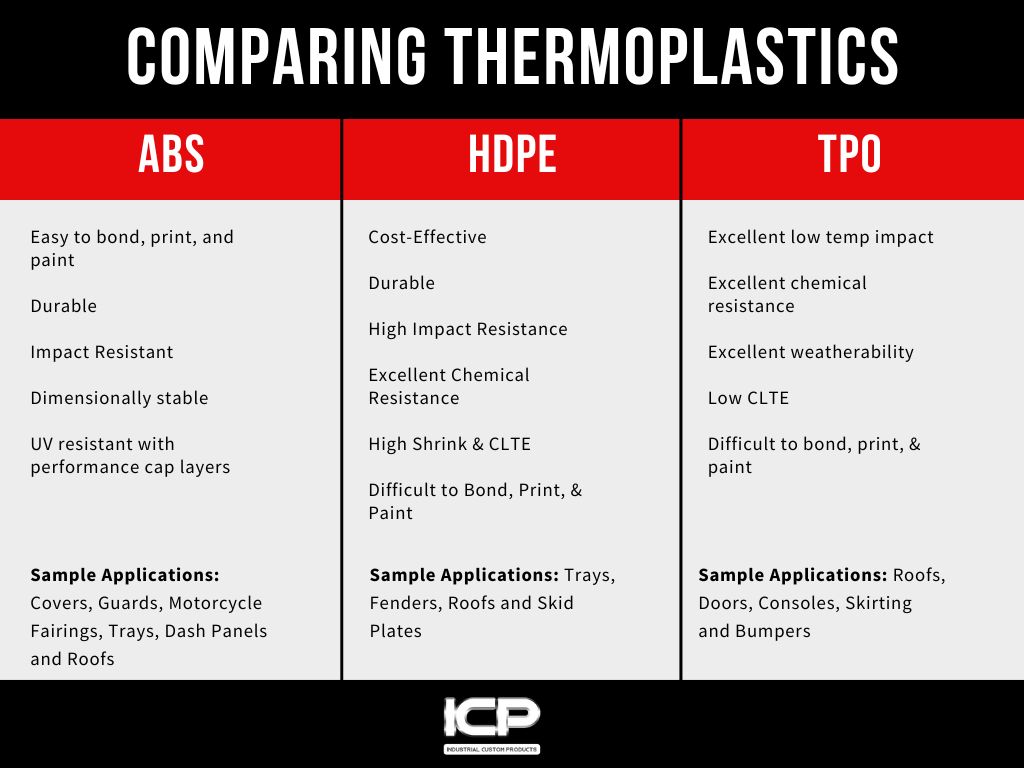
Quick Comparison: ABS vs. HDPE vs. TPO
|
Material |
Best Fit |
Key Strengths |
Sample Applications |
|
ABS |
Parts that need strength, stiffness, and dimensional stability |
Easy to bond, print, and paint; durable; impact resistant; dimensionally stable; UV resistant with performance cap layers |
Covers, guards, motorcycle fairings, trays, dash panels, roofs |
|
HDPE |
Parts that need chemical resistance, impact resistance, and cost-effective durability |
Cost-effective; durable; high impact resistance; excellent chemical resistance |
Trays, fenders, roofs, skid plates |
|
TPO |
Exterior applications that need weatherability, impact resistance, and customization |
Excellent low-temperature impact, chemical resistance, weatherability, low CLTE, color/finish/adhesive customization |
Roofs, doors, consoles, skirting, bumpers |
Acrylonitrile Butadiene Styrene (ABS): Strength, Stability, and Appearance
ABS is a versatile plastic that’s ideal for applications where strength, stiffness and dimensional stability are important. For that reason, it’s a popular choice for the automotive, recreational vehicle and construction industries.
It is commonly used for:
- Covers
- Guards
- Motorcycle fairings
- Trays
- Dash panels
- Roofs
Why Engineers Choose ABS
ABS offers a balance of:
- Durability
- Impact resistance
- Dimensional stability
- Easy bonding
- Easy printing and painting
- UV resistance with performance cap layers
For many applications, ABS provides a more refined cosmetic appearance while still maintaining strong overall durability.
Where ABS May Not Be Ideal
ABS may not be the best fit for:
- Applications requiring strong chemical resistance
- Parts exposed to constant impact
- Applications where high flexibility is needed
In those cases, HDPE or TPO may offer advantages depending on the environment and performance requirements.
High Density Polyethylene (HDPE): Chemical Resistance and Cost-Effective Durability
Polyethylene (PE) is one of the most commonly used plastics in manufacturing. It’s a rigid plastic resin with high chemical resistance. HDPE is a variation of PE that has an extremely high impact resistance and high tensile strength. It can also be recycled and used over again. However, because of that same recyclability, it’s best suited to low temperature applications.
It is commonly used for:
- Trays
- Fenders
- Roofs
- Skid plates
Why Engineers Choose HDPE
HDPE offers a balance of:
- High impact resistance
- Excellent chemical resistance
- Durability
- Cost-effective performance
- Recyclability
HDPE is often a practical choice for applications where long-term toughness and environmental resistance matter more than cosmetic finish or secondary finishing processes.
Where HDPE May Not Be Ideal
HDPE may not be the best fit for:
- Applications requiring easy bonding
- Parts that need printing or painting
- Projects with tight dimensional stability requirements due to high shrink and CLTE
In those situations, ABS or TPO may provide better performance depending on the application.
Thermoplastic Olefin (TPO): Weatherability and Exterior Impact Performance
TPO is a combination of polypropylene, elastomers and mineral fillers offering a unique balance of stiffness and thermal expansion. TPO has superior weather-ability so it does not require a cap and it ranks extremely high on impact and chemical resistance. TPO can be easily customized with color, finish and adhesives. This makes it a popular choice for automotive and recreational vehicles for exterior applications.
It is commonly used for:
- Roofs
- Doors
- Consoles
- Skirting
- Bumpers
Why Engineers Choose TPO
TPO offers a balance of:
- Excellent low-temperature impact resistance
- Excellent chemical resistance
- Excellent weatherability
- Low CLTE
- Color and finish customization options
- Adhesive customization capabilities
TPO is frequently used in automotive and recreational vehicle applications where exterior durability and appearance both matter.
Where TPO May Not Be Ideal
TPO may not be the best fit for:
- Applications requiring easy bonding
- Parts that need printing or painting
- Projects where secondary finishing processes are a major requirement
Those considerations should be evaluated early during material selection and DFM discussions.
Choosing the Right Thermoplastic Starts Early
Material selection isn’t about finding “the best material”: it’s about finding a material that will perform over time in the real environment of your specific application. This is a multi-faceted approach that includes decision-making factors like:
- Impact resistance
- UV exposure
- Chemical exposure
- Corrosion resistance
- Dent resistance
- Weight reduction
- Cosmetic requirements
- Temperature fluctuations
- Long-term wear
- Ease of manufacturing
This is why thermoplastics can sometimes outperform traditional materials like metal or fiberglass, especially in applications where corrosion, denting, weight, or environmental exposure become ongoing challenges.
It is also why material selection should never happen separately from manufacturability discussions.
A material may appear ideal on paper but create challenges later with tooling, part geometry, production consistency, surface finish, assembly requirements, or long-term durability. Those issues are much easier to address early than after a design moves deeper into production.
At Industrial Custom Products, DFM reviews help engineering, sourcing, and procurement teams evaluate not just which material could work, but which material makes the most sense for the application, manufacturing process, and long-term goals of the part.
Whether you are comparing ABS, HDPE, TPO, or evaluating a conversion from metal or fiberglass, early collaboration helps reduce production risk and avoid costly redesigns later in the process.
Industrial Custom Products is a one-stop-shop for custom manufacturing and plastic fabrication, including: prototyping and product development, die cutting and dieless knife cutting, thermoforming and vacuum forming, large part thermoforming, CNC plastic routing, fabrication and assembly and drape forming.