---
title: Material Substitution Without Redesigning the Entire Part
description: Material substitution doesn’t have to mean a full redesign. Learn how engineers can change materials while reduce risk and preserving part designs.
image: https://industrialcustom.com/hubfs/Imported_Blog_Media/swap%20graphic.jpeg
---
[Skip to main content](https://industrialcustom.com/blogs/material-substitution-without-redesigning-the-entire-part#main)
[EMAIL US](mailto:icp@industrialcustom.com) | [612-781-2255](tel:6127812255) | [TOLL FREE: 877-784-2415](tel:8777842415)
[   ](https://industrialcustom.com)
[Request a Quote](https://industrialcustom.com/request-a-quote)
[Contact Us](https://industrialcustom.com/contact-us)
- [Home](https://industrialcustom.com)
- [About](https://industrialcustom.com/about-us)
- Show submenu for Capabilities Capabilities
- [Design for Manufacturability Review](https://industrialcustom.com/dfm-review)
- [Rapid Prototyping](https://industrialcustom.com/rapid-prototyping)
- [Innovative Thermoforming & Vacuum Forming](https://industrialcustom.com/thermo-and-vacuum-forming)
- [Large Part Thermoforming](https://industrialcustom.com/thermoforming)
- [Die Cutting](https://industrialcustom.com/die-cutting)
- [Flash Cutting](https://industrialcustom.com/dieless-knife-cutting)
- [Custom Plastic Fabrication](https://industrialcustom.com/custom-plastic-fabrication)
- [CNC Plastic Routing](https://industrialcustom.com/plastic-routing)
- Show submenu for Industries Industries
- [Powersports & Marine OEMs](https://industrialcustom.com/powersports-marine-recreational)
- [Agriculture & Heavy Truck OEMs](https://industrialcustom.com/agriculture-heavy-truck)
- [Industrial OEMs](https://industrialcustom.com/industrial)
- [Medical OEMs](https://industrialcustom.com/medical)
- [All Industries Served](https://industrialcustom.com/industries-served)
- [Materials](https://industrialcustom.com/materials-page)
- [Quality](https://industrialcustom.com/icp-quality)
- [Videos](https://industrialcustom.com/videos)
- Show submenu for What We Do What We Do
- [Portfolio](https://industrialcustom.com/portfolio)
- [Case Studies](https://industrialcustom.com/case-studies)
- [Blogs](https://industrialcustom.com/blogs)
Open main navigation
Close main navigation
- [Home](https://industrialcustom.com)
- [About](https://industrialcustom.com/about-us)
- Show submenu for Capabilities Capabilities
- Capabilities
- [Design for Manufacturability Review](https://industrialcustom.com/dfm-review)
- [Rapid Prototyping](https://industrialcustom.com/rapid-prototyping)
- [Innovative Thermoforming & Vacuum Forming](https://industrialcustom.com/thermo-and-vacuum-forming)
- [Large Part Thermoforming](https://industrialcustom.com/thermoforming)
- [Die Cutting](https://industrialcustom.com/die-cutting)
- [Flash Cutting](https://industrialcustom.com/dieless-knife-cutting)
- [Custom Plastic Fabrication](https://industrialcustom.com/custom-plastic-fabrication)
- [CNC Plastic Routing](https://industrialcustom.com/plastic-routing)
- Show submenu for Industries Industries
- Industries
- [Powersports & Marine OEMs](https://industrialcustom.com/powersports-marine-recreational)
- [Agriculture & Heavy Truck OEMs](https://industrialcustom.com/agriculture-heavy-truck)
- [Industrial OEMs](https://industrialcustom.com/industrial)
- [Medical OEMs](https://industrialcustom.com/medical)
- [All Industries Served](https://industrialcustom.com/industries-served)
- [Materials](https://industrialcustom.com/materials-page)
- [Quality](https://industrialcustom.com/icp-quality)
- [Videos](https://industrialcustom.com/videos)
- Show submenu for What We Do What We Do
- What We Do
- [Portfolio](https://industrialcustom.com/portfolio)
- [Case Studies](https://industrialcustom.com/case-studies)
- [Blogs](https://industrialcustom.com/blogs)
- [Request a Quote](https://industrialcustom.com/request-a-quote)
[Contact Us](https://industrialcustom.com/contact-us)

# Material Substitution Without Redesigning the Entire Part
March 19, 2026
Material substitution usually enters the conversation at an inconvenient time. Current material costs have jumped. A part is underperforming in the real world. Onshoring becomes a priority. Suddenly a design that has been “good enough” for years is back under scrutiny. Engineers may be open to changing materials to improve performance, but the idea of redesigning an entire part can stop the conversation fast. There’s one big problem with that approach: waiting until you have to make a change is often too late. By then, you’ve already experienced a significant cost increase that forces your hand.
Yet, that hesitation to revisit a currently performing part is reasonable. Redesigning a part can trigger a cascade of changes. The fear isn’t a new material itself: it’s everything that comes with touching the design.
The reality is that material substitution does not always require starting over. In many cases, it is possible to change materials while preserving the core design of the original part.
## Why Material Changes Feel Risky
By those further away from the manufacturing process, material substitution is framed as a simple swap. One material out, another in. That framing sets teams up for problems because it ignores how materials behave differently during fabrication and in real-world use.
Engineers are trained to respect unintended consequences. Changing a material can affect stiffness, impact resistance, thermal behavior, surface finish, and manufacturability. Even small differences can show up later as warping, cracking, or assembly issues.
## Removing the Risk From Material Substitution
Material substitution tends to stall when engineers or procurement specialists are asked to solve everything alone.
Evaluating new materials, predicting performance changes, ensuring manufacturability and coordinating with production and suppliers. That workload adds up quickly, especially when the part already exists and is in production. That can make it hard to muster up the motivation to explore new choices.
This is where Design for Manufacturability (DFM) makes a practical difference. ICP’s [DFM](https://industrialcustom.com/dfm-review) shifts the work from theoretical optimization to applied problem-solving. Instead of asking in-house employes to redesign a part to fit a material, our DFM process asks how the material and manufacturing method can be adapted to the existing design intent.
Let’s walk through an example: fiberglass vs. thermoplastics. Fiberglass parts often deliver strength and durability, but they also bring added weight and cracking risk. Thermoplastics can offer lighter weight, better impact performance, and more consistent manufacturing. Moving from fiberglass to plastics does not automatically require a full redesign.
Related Content: [Thermoplastics vs. Fiberglass: A Comparison for OEMs](https://industrialcustom.com/blogs/thermoplastics-vs.-fiberglass-a-comparison-for-oems)
## Real-World Examples of Substitution Without Starting Over
ICP has worked with OEM teams to replace existing components with thermoplastic alternatives while preserving critical interfaces and assemblies. In these cases, the goals were weight reduction, improved durability, shorter lead times, and/or better cost control.
By analyzing how the original part was used and where failures or inefficiencies occurred, ICP was able to recommend material and process changes that fit within existing design constraints.

### Example One: Troubleshooting Tricky TPO Consoles
[A marine OEM](https://industrialcustom.com/blogs/case-study-troubleshooting-tricky-tpo-consoles)was struggling with cracking in its consoles. ICP stepped in, reviewed the part’s performance history, and re-engineered the process rather than redesigning the part from scratch. We were able to move from ABS to the tougher TPO to improve impact resistance.
Through targeted tooling and troubleshooting, ICP produced impact-resistant TPO consoles that met performance goals and helped the customer fulfill a production backlog — all while keeping the original fit and function intact.
### Example Two: Crenlo Engineered Cabs
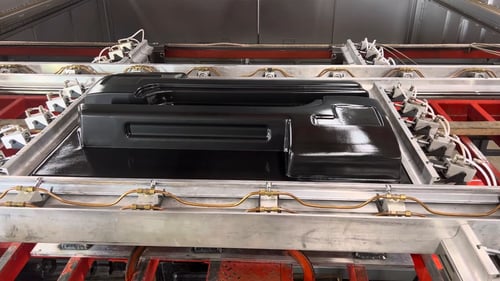
For [Crenlo](https://industrialcustom.com/blogs/case-studies/case-study-crenlo-engineered-cabs), the issue with their current part wasn’t design so much as how the material worked within the larger production process. Their skirts required significant prep work before painting because the previous material was low surface energy and hard to bond. ICP selected a different TPO with a directly paintable surface and higher melt strength to reduce warpage during the bake cycle. This change didn’t require significant retooling. Instead, it eliminated prep steps, reduced rework, and lowered overall costs while maintaining the original part design.

### Example Three: Airport Rescue Fire Truck
An [OEM building airport rescue fire trucks](https://industrialcustom.com/blogs/case-studies/case-study-airport-rescue-fire-truck) needed to cut vehicle weight without compromising performance. Instead of redesigning each part, ICP worked with the customer to identify more than 20 existing fiberglass components that could be converted to thermoformed plastics. By focusing on material and process substitution while retaining the original geometry and mounting interfaces, ICP cut significant weight, which directly helped the truck meet acceleration goals. The result was a lighter, production-ready fleet of parts with no structural redesign required.
Material substitution does not have to mean redesigning the entire part, rewriting every drawing, or restarting validation from zero.
When approached through DFM and real manufacturing experience, substitution becomes a controlled adjustment rather than a disruptive event. The goal isn’t to change materials for the sake of change. It’s to remove friction, reduce risk, and let parts perform better in the environments they actually face. By kickstarting this process before a problem emerges, you’re positioned to maximize efficiency and results.
By reviewing parts through a manufacturing-first lens, ICP helps teams understand where material flexibility exists and what changes can be made without triggering a full redesign.
[Request a DFM Review](https://industrialcustom.com/dfm-review)
---
*Industrial Custom Products is a one-stop-shop for custom manufacturing and plastic fabrication, including: prototyping and product development, die cutting and dieless knife cutting, thermoforming and vacuum forming, large part thermoforming, CNC plastic routing, fabrication and assembly and drape forming.*
**Tags:**
[Manufacturing,](https://industrialcustom.com/blogs/tag/manufacturing) [Custom Manufacturing,](https://industrialcustom.com/blogs/tag/custom-manufacturing) [Design,](https://industrialcustom.com/blogs/tag/design) [Plastics](https://industrialcustom.com/blogs/tag/plastics)
### Reputation Built on Quality and Experience
**HAVE A QUESTION ? WE ARE HERE FOR YOU.**
**[2801 37TH AVENUE N.E. MINNEAPOLIS MN 55421-4217](https://goo.gl/maps/tVLhPhVqv58WjtT87)**
**TEL : [612-781-2255](tel:6127812255)**
**FAX : 612-781-1144**
**TOLL FREE : [877-784-2415](tel:8777842415)**
**EMAIL : [ICP@INDUSTRIALCUSTOM.COM](mailto:icp@industrialcustom.com)**
[](https://industrialcustom.com)
- [Custom Plastic Fabrication](https://industrialcustom.com/custom-plastic-fabrication)
- [Die Cutting](https://industrialcustom.com/die-cutting)
- [Thermoforming & Vacuum Forming](https://industrialcustom.com/thermo-and-vacuum-forming)
- [Design for Manufacturability Review](https://industrialcustom.com/dfm-review)
-
-
-
Copyright © 2026 Industrial Custom Products | All Rights Reserved | [Privacy Policy](http://45684422.hs-sites.com/privacy-policy) | [Terms of Use](http://45684422.hs-sites.com/terms-and-conditions) | Minneapolis Web Design by BizzyWeb
[](https://industrialcustom.com/hubfs/Documents%20and%20Certifications/ICP-1919US-24-25.pdf) 
```json
{
"@context" : "https://schema.org",
"@type" : "BlogPosting",
"author" : {
"@type" : "Person",
"name" : "Adam Lunde",
"url" : "https://industrialcustom.com/blogs/author/adam-lunde"
},
"dateModified" : "2026-03-19T19:20:38.349Z",
"datePublished" : "2026-03-19T19:20:38.000Z",
"headline" : "Material Substitution Without Redesigning the Entire Part",
"image" : [ "https://industrialcustom.com/hubfs/Imported_Blog_Media/swap%20graphic.jpeg" ],
"mainEntityOfPage" : {
"@id" : "https://industrialcustom.com/blogs/material-substitution-without-redesigning-the-entire-part",
"@type" : "WebPage"
},
"publisher" : {
"@type" : "Organization",
"logo" : {
"@type" : "ImageObject",
"url" : "https://industrialcustom.com/hubfs/icp-logo-trans.png"
}
}
}
```